
From systems thinking to real change: Nikola Paj’s BECOME experience
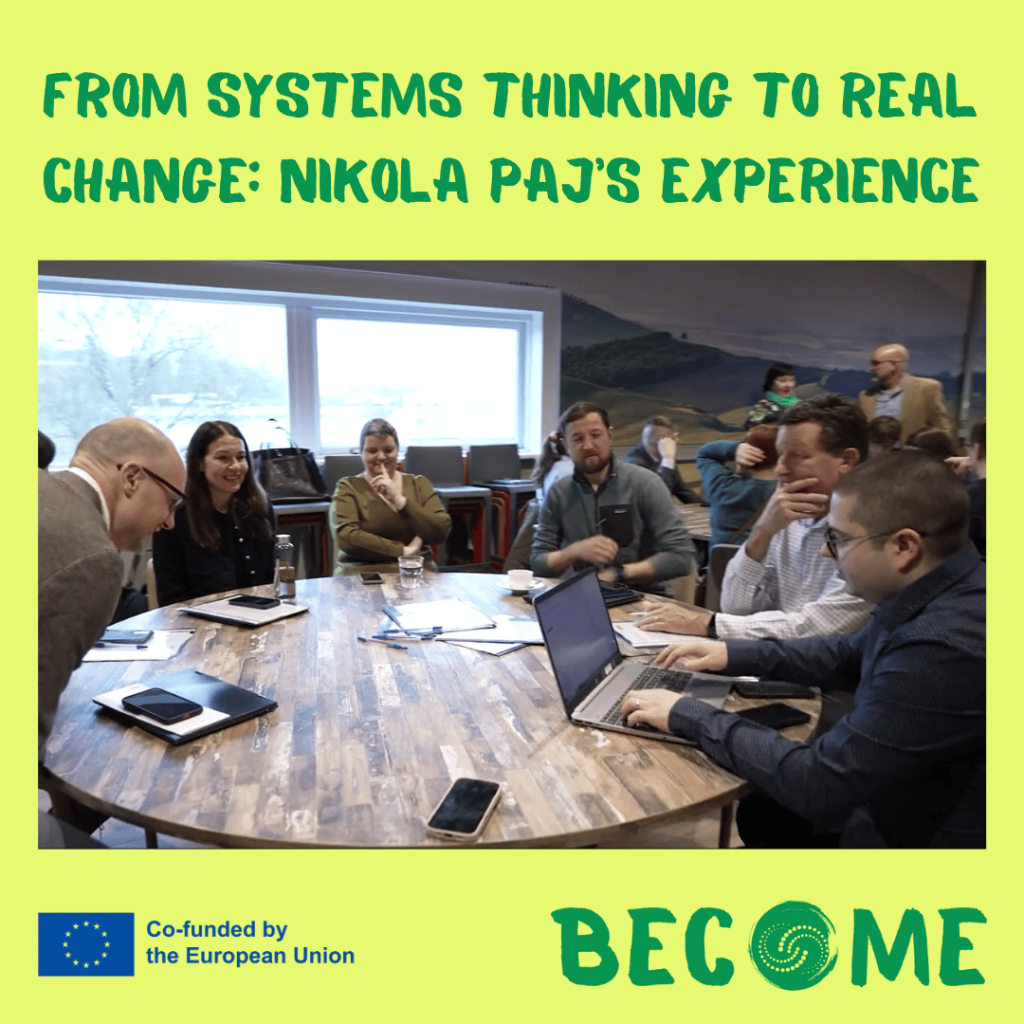
After the BECOME Professionals Training, we spoke with Nikola Paj, Head of Safety and Environmental Protection at Mlinar, the largest bakery industry in Croatia. With a strong background in environmental protection and a passion for education, Nikola joined the 5-day training to deepen his understanding of circular economy principles and explore practical applications within industry.
From operational focus to systems thinking
Nikola entered the training with a clear goal: to gain structured, applicable knowledge of the circular economy. What he discovered went beyond expectations.
“Before the training, I focused mainly on operational improvements like waste reduction and resource efficiency. Now, I see circular economy as a strategic framework that connects the entire product life cycle and all business processes.”
A key concept that reshaped his thinking was systems thinking. In complex industrial environments, Nikola emphasizes that production, logistics, and waste management are deeply interconnected. Addressing one area in isolation often leads to short-term or incomplete solutions.
Learning by doing
One of the highlights of the BECOME-training was its hands-on approach. Workshops allowed participants to immediately apply theoretical concepts to real-world scenarios.
“The workshops were essential. They allowed us to test ideas in practice, which is critical for effective learning.”
The onsite training in the Netherlands further strengthened this experience, offering direct insight into how circular principles are implemented in real business settings.
From data to impact
Nikola also highlighted the importance of data-driven decision-making.
“To reduce waste, we first need high-quality data and a clear understanding of our current situation. But data alone is not enough—we must combine it with real operational insight.”
This combination enables organizations to identify root causes of inefficiencies and implement targeted improvements with measurable results.
Circular economy in action
A standout moment during the training was the company visit to Heijmans.
Nikola was particularly impressed by their integrated approach:
- strong focus on biodiversity, including wildlife-friendly infrastructure
- use of electric heavy machinery, demonstrating that sustainable solutions are already viable at scale
“This showed clearly that circular economy is not just a concept, but something that can be implemented in complex industrial systems.”
Collaboration as a catalyst
Working alongside professionals from different countries and sectors proved transformative.
“Initially, I felt uncertain. But this diversity turned out to be one of the most valuable aspects. Different perspectives are not a barrier—they are an opportunity.”
Nikola also stresses the importance of collaboration between industry and education, noting that real progress happens when theory and practice inform each other.
Turning ideas into action
Following the training, Nikola is already working on several concrete initiatives:
- energy optimization through battery systems to manage peak loads
- transition toward electrification and reduced reliance on diesel generators
- reducing food waste through better integration of planning and operations
- strengthening environmental management systems aligned with ISO 14001
“These are not just ideas—they are steps toward measurable and structured change.”
Looking ahead
Nikola sees the greatest opportunities for circular economy in his sector in:
- energy systems and decarbonization
- efficient raw material use
- food waste reduction
“These areas offer the fastest and most powerful impact.”
A simple but powerful lesson
When asked to summarize his journey, Nikola shared:
“Change does not come from large ideas, but from the consistent application of small, everyday decisions and continuous learning.”
Would he recommend the training?
Without hesitation he said yes!
“The program provides a structured approach with strong practical focus and international exchange. It’s especially valuable for professionals who want to move from theory to real implementation.”
Later this year, the BECOME-training modules will become available, offering more professionals the opportunity to learn and apply circular economy principles in practice.